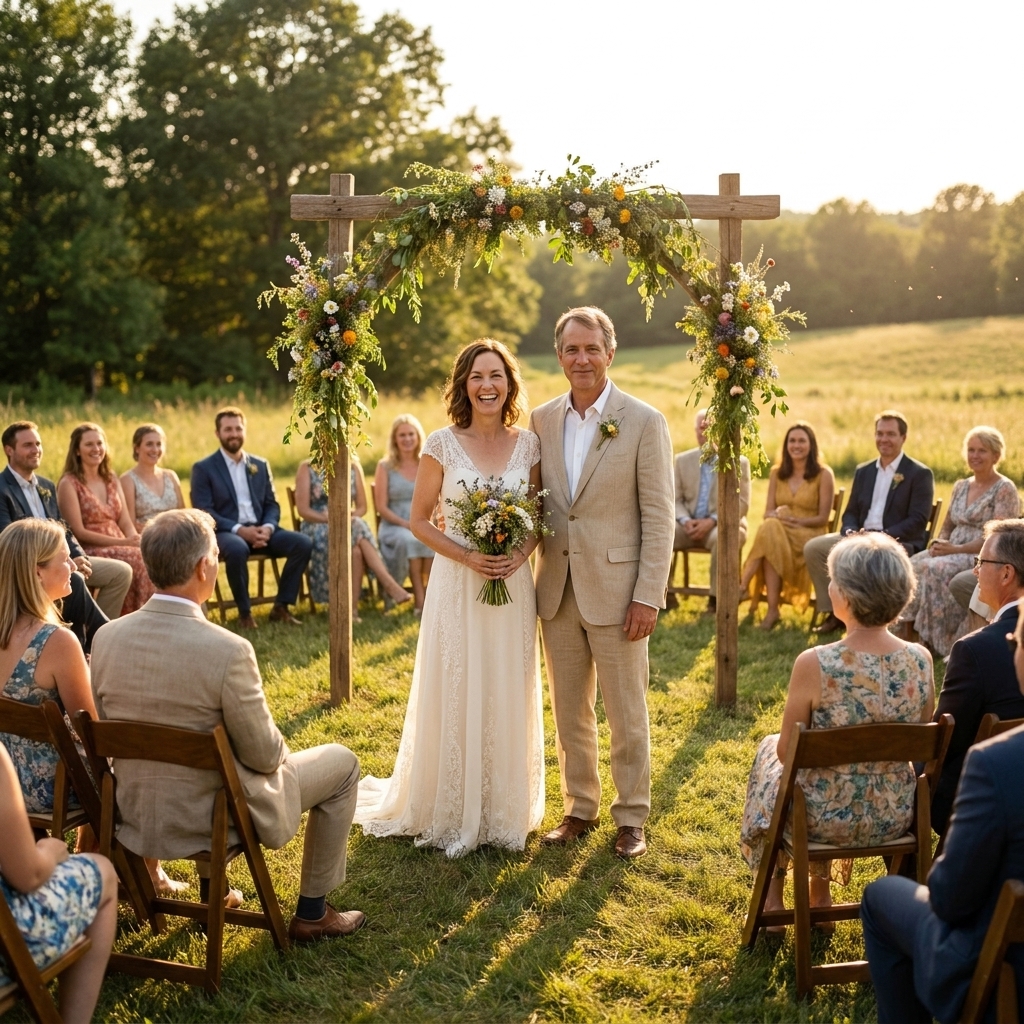
When I planned weddings, I watched the same moment unfold again and again: a couple takes hands, the room goes wonderfully quiet, and suddenly the words matter more than the flowers, the lighting, or the timeline. If you are staring at a blank page right now, you are not behind. You are right on time. Writing vows is tender work.
This guide will help you turn “I love you” into something specific, true, and speakable. We will use structure to make space for your heart, because connection is always more important than perfection.

Before you write: align on the basics
Ten minutes of agreement now will save you from stress later, especially if you are writing separately.
- Length: Aim for 60 to 120 seconds each (about 150 to 300 spoken words). If one of you loves a long story and the other is brief, agree on a range.
- Tone: Romantic, playful, poetic, straightforward, faith-forward, or a blend. Choose the lane together.
- Privacy: Are you reading them aloud, exchanging letters privately, or doing both?
- Content boundaries: Decide what stays off-limits (exes, inside jokes that exclude guests, overly personal details, or anything that would embarrass a parent in the front row).
- Who approves them: Some couples keep them fully secret. Others share with the officiant or a trusted friend for pacing and volume practice. Either is fine.
Elise tip: If you are nervous, ask your officiant for a “repeat-after-me” backup plan. You can still write personal vows for a private moment and use simpler vows in the ceremony.
A simple vow writing process
Step 1: Collect raw material (15 minutes)
Open a note on your phone or a page in a notebook and answer these quickly, without polishing.
- When did I realize this was my person?
- What do they do that makes me feel safe?
- What do they do that makes life more fun?
- What hard thing have we already gotten through?
- What ordinary moment with them feels sacred?
- What do I admire most about their character?
Step 2: Choose one anchor story (10 minutes)
A meaningful vow usually has one clear moment that makes the love feel real. Pick a story you can tell in two or three sentences. Think: the rainy road trip, the hospital waiting room, the Tuesday night you laughed until you cried, the way they showed up when you were exhausted.
Step 3: Name what love looks like (10 minutes)
This is the heart of personalization. Love is not just a feeling. It is a pattern. Write 3 to 5 “truths” about your relationship.
- “We are the kind of couple who...”
- “With you, I have learned...”
- “You make home feel like...”
Step 4: Write your promises (15 minutes)
Promises are what makes vows vows. Aim for 4 to 7 promises that are both romantic and livable. The best promises are specific enough to picture and broad enough to last through decades.
Step 5: Draft your ending (5 minutes)
Close with a line that lands: a simple commitment, a hope for your life together, or a final “I choose you.”
Step 6: Edit for speaking (20 minutes)
Read it out loud. Edit anything you stumble over. Most people write too formally at first. Your vows should sound like you on your best day, not like a greeting card.

A vow structure that works
If you want a reliable outline, borrow this. It is classic for a reason.
- Opening: Address your partner and set the tone. (1 to 2 sentences)
- Anchor story: One moment that captures your relationship. (2 to 4 sentences)
- What you love and admire: The character and the everyday. (3 to 5 sentences)
- Promises: 4 to 7 vows.
- Closing: A final commitment and a look ahead. (1 to 3 sentences)
Keep it human: If you cannot imagine saying it across the kitchen while making coffee, simplify it until you can.
Three fill-in templates
Template 1: Classic
Opening: “[Name], today I choose you.”
Anchor story: “I knew I wanted this life with you when [specific moment]. In that moment, I saw [what it revealed about them or you together].”
What I love: “I love the way you [everyday thing]. I admire your [character trait], and how you make people feel [effect].”
Promises: “I promise to [promise]. I promise to [promise]...”
Closing: “I will keep choosing you, in the ordinary and the extraordinary, for the rest of my life.”
Template 2: Warm and funny
Opening: “[Name], you are my favorite person and my safest place.”
Anchor story: “Remember [shared memory]? That is when I thought, ‘Oh. This is it.’”
What I love: “I love your [quirk], your [strength], and the way you [care for others].”
Promises: “I promise to keep laughing with you. I promise to be on your team, especially when life is messy. I promise to [specific practical promise].”
Closing: “You are my home, and I cannot wait to build a life that feels like us.”
Template 3: Short and sincere
“[Name], loving you has made my life bigger and gentler. I love your [trait] and the way you [specific example]. I promise to show up, to tell the truth with kindness, to keep learning you, and to choose our marriage every day. I love you. I choose you. I am yours.”
Vow examples
Example 1: Classic
“Maya, I knew I wanted to marry you the night we got lost coming back from the lake and neither of us panicked. You turned on a playlist, you reached for my hand, and somehow the wrong turn felt like an adventure. That is who you are. You make space for joy, even when life is uncertain.
I love your steadiness, your ridiculous commitment to sending thank-you notes, and the way you treat my family like they have always been yours. You make me want to be a softer person and a braver one.
I promise to listen first and fix later. I promise to celebrate you, not just our milestones. I promise to be honest, especially when it is hard. I promise to keep our home full of laughter and good food. I promise to choose you, again and again, for as long as we both live.
Maya, you are my best friend. I am so proud to be your partner. Today, I choose you.”
Example 2: Modern
“Jordan, you are the person I want to tell everything to, from the big news to the most unnecessary little detail. I fell in love with you in a hundred small moments, but I think I knew for sure when you stayed up late helping me practice for an interview you had nothing to gain from. You just wanted me to win.
I love how you make room for people. I love your curiosity, your patience, and your very strong opinions about tacos. I love that with you, the future feels like something we can handle.
I promise to be on your side, even when we disagree. I promise to apologize without keeping score. I promise to keep dating you. I promise to take care of our life, our family, and our ordinary Tuesday nights. I promise to love you with intention for the rest of my days.”
Example 3: Ceremony-friendly
“Sam, you are my favorite place to land. I love your kindness and the way you show up, consistently, for the people you love. I promise to be your partner in all seasons. I promise to speak to you with respect, to protect our peace, and to keep choosing us. I love you, and I will for the rest of my life.”
Promises that feel real
If “I promise to love you forever” feels too big to grip, try promises that show how you will love.
Everyday care
- I promise to make our home a place where you can exhale.
- I promise to notice the small things and say thank you often.
- I promise to be faithful with my time, attention, and words.
Communication and repair
- I promise to listen with curiosity, not defensiveness.
- I promise to take breaks when we are heated and return to the conversation.
- I promise to apologize without excuses and forgive without keeping score.
Adventure and growth
- I promise to keep learning you as you grow and change.
- I promise to protect our joy and make room for fun.
- I promise to be brave with you, even when the next step is unknown.
Family and future
- I promise to honor the family we come from while building the family we choose.
- I promise to be a steady partner in our decisions, our finances, and our dreams.
- I promise to show up for you in illness, in health, and in all the in-between days.
How to beat writer’s block
Try a voice note
Open your phone and record yourself answering: “What do I want them to know on our wedding day?” Talk for two minutes. Transcribe it. That is usually closer to your real voice than anything you type.
Write a letter first
Start with “Here is what I love about being with you...” and do not mention promises at all. After a page, circle the lines that feel most true. Those become your vows.
Use a 10-minute sprint
Set a timer. Write badly on purpose. You cannot edit a blank page, but you can absolutely edit a messy one.
Borrow structure, not sentences
It is completely fine to use a template. Your job is to fill it with your names, your stories, your promises. That is what makes it original.
Editing checklist
- Replace vague words (amazing, perfect, soulmate) with specifics (steady, curious, generous, brave).
- Cut anything you would not say out loud. If it feels too formal, it probably is.
- Limit the “remember when” list. One anchor story is plenty.
- Balance admiration with commitment. If it is all compliments, add promises. If it is all promises, add warmth.
- Read for rhythm. Vary sentence length. Add a pause where you might breathe.
- Avoid private codes. Inside jokes should still feel welcoming to guests.
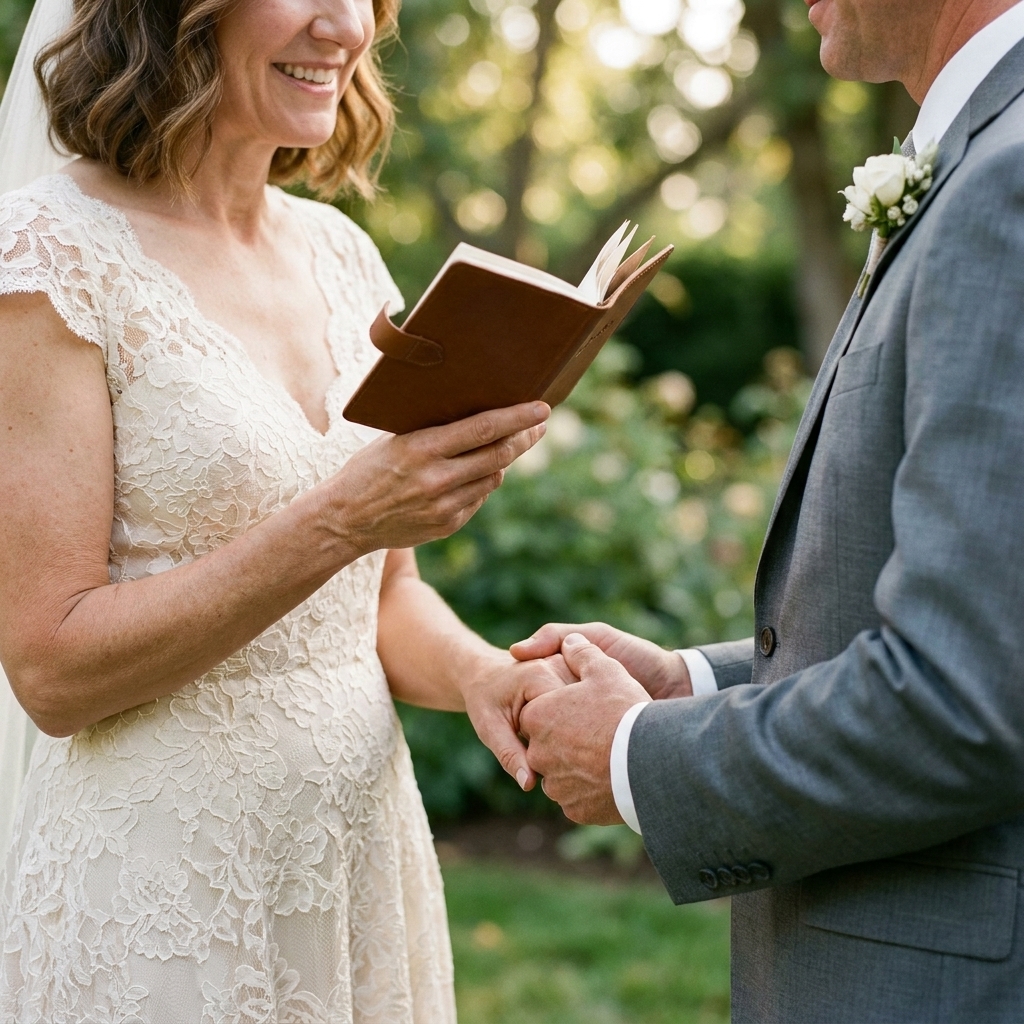
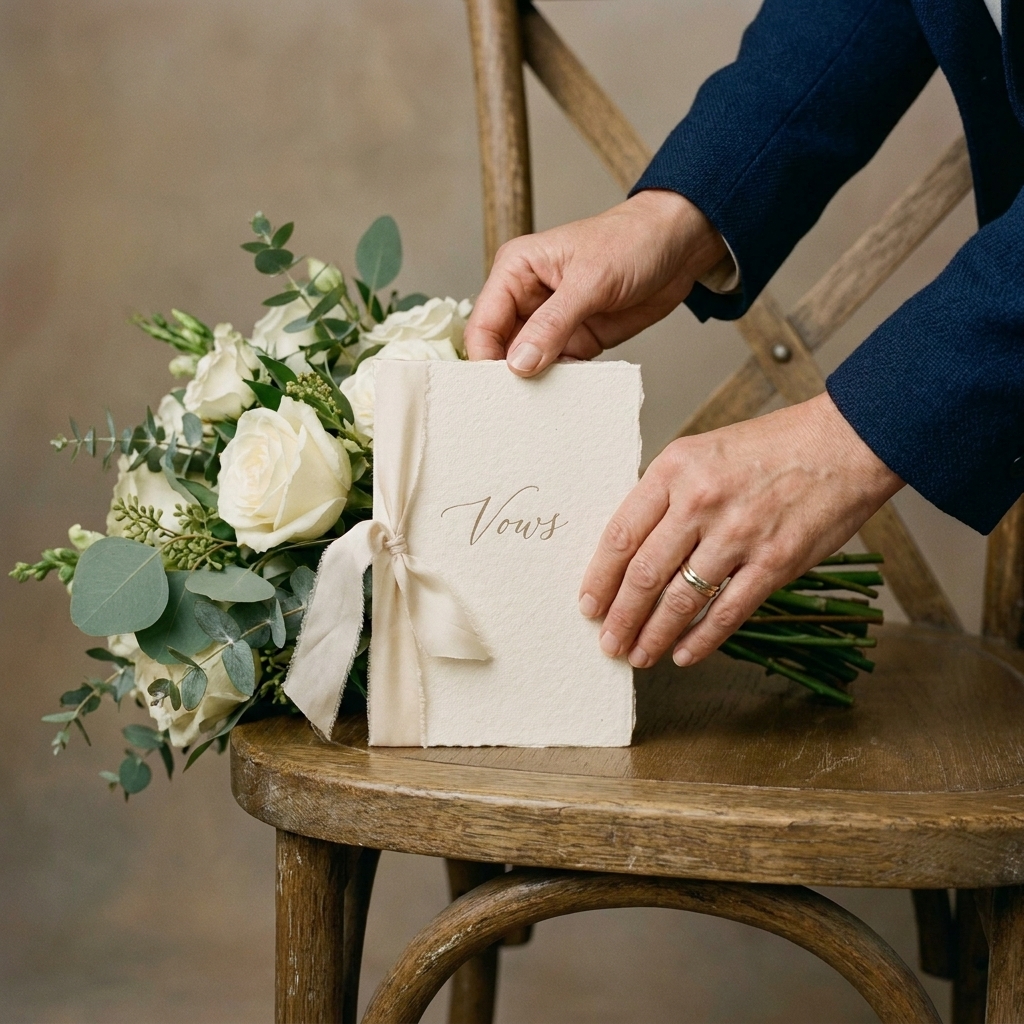
Practical note: Print your vows in a larger font or write them neatly in a vow book. Phones are bright, distracting, and easy to fumble.
Day-of delivery tips
- Practice twice: Once alone, once in front of a mirror or a trusted friend.
- Bring a backup copy: Give one to your officiant or tuck it in a labeled envelope.
- Speak slower than you think you should: Emotion speeds us up.
- Pause for connection: Look at your partner between paragraphs.
- Keep water nearby: Dry mouth is real.
Frequently asked questions
How long should wedding vows be?
Most couples are happiest around 60 to 120 seconds each. If you are both comfortable with longer, keep it consistent so one person does not feel rushed or outshined.
Should we share our vows before the wedding?
There is no etiquette rule either way. If you love the surprise, keep them private. If you worry about length or tone mismatch, share them with your officiant or a trusted friend instead.
Can we include humor?
Yes, as long as it is kind and inclusive. Use humor that celebrates your partner, not humor that teases their insecurities or makes guests feel like they missed the joke.
What if one of us is more emotional?
Different delivery styles are normal. Match length and sincerity, not personality. A quiet, steady vow can be just as moving as a tearful one.
What if I cry and cannot finish?
Pause. Breathe. Let your partner hold your hands. It is okay. If you want a safety net, ask your officiant to keep a copy so they can gently prompt you if needed.
A final reminder
Your vows do not need to impress anyone. They need to tell the truth. If you can name one real story, one real reason, and a handful of real promises, you have written vows that will hold up for a lifetime.
Take the structure in this guide, choose the tone that feels most like you, and fill it with what only you can say: the moment you knew, the small things you love, and the promises you mean to keep. Read it out loud. Make it speakable. Then show up and tell the truth.